
Hydrology is the scientific study of water — its occurrence, distribution, movement, and properties as it circulates through the Earth’s atmosphere, land surface, and subsurface. It examines the complete water cycle (hydrologic cycle), including evaporation, condensation, precipitation, infiltration, runoff, and storage in rivers, lakes, groundwater aquifers, glaciers, and oceans. In essence, hydrology tries to answer where water comes from, where it goes, how much of it there is, and how fast it moves through natural and human-influenced systems.
As a discipline, hydrology draws on physics, chemistry, geology, biology, and mathematics to understand and quantify water-related processes. It is often divided into subfields: surface water hydrology (rivers, lakes, streams), groundwater hydrology or hydrogeology (water beneath the Earth’s surface), and atmospheric hydrology (precipitation and evaporation processes). Hydrologists use tools like rainfall-runoff models, remote sensing, and stream gauges to measure and predict water behavior over time and across different landscapes.
Beyond its scientific value, hydrology has significant practical applications. It underpins water resource management, flood forecasting and control, drought planning, irrigation design, dam and reservoir engineering, and the assessment of water quality and pollution. It also plays a critical role in understanding the impacts of climate change and land-use changes — such as deforestation or urbanization — on water availability and flooding risk. Because water is essential to nearly every aspect of human life and ecosystems, hydrology serves as a foundational science for engineering, environmental planning, and sustainable development.
Why does hydrology matter?
Water is constantly moving and changing state, and hydrology helps us understand and predict that movement. This is important because water availability affects agriculture, drinking water supplies, energy production (like hydropower), ecosystems, and even the stability of the ground we build on. Hydrologists study questions like: How much rainfall will a region get, and when? How will a river’s flow change after a big storm? How much water is stored underground, and how quickly is it being used up? Will a certain area be at risk of flooding or drought?
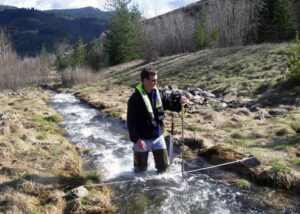
It’s important for several key reasons:
1. Water Resource Management
Understanding how much water is available, where it comes from, and how it flows helps societies plan for drinking water supply, irrigation, and industrial use — especially as demand grows and supplies become stressed.
2. Flood and Drought Prediction
Hydrologists model rainfall-runoff patterns and river behavior to forecast floods and droughts, giving communities time to prepare, evacuate, or manage water storage.
3. Infrastructure Design
Engineers rely on hydrological data to design dams, bridges, drainage systems, levees, and reservoirs that can handle expected water flows without failing.
4. Agriculture
Crop planning, irrigation scheduling, and soil moisture management all depend on hydrological understanding — critical for food security.
5. Ecosystem Health
Rivers, wetlands, and lakes support biodiversity. Hydrology helps track how changes in water flow (from dams, pollution, or climate shifts) affect aquatic and surrounding ecosystems.
6. Climate Change Adaptation
As precipitation patterns shift, hydrology helps predict changes in water availability, glacier melt, sea level rise, and extreme weather events — informing adaptation strategies.
7. Groundwater Protection
A large share of the world’s freshwater comes from aquifers. Hydrology helps prevent over-extraction and contamination of these often slow-to-recharge resources.
8. Urban Planning
Understanding stormwater runoff and drainage is essential for designing cities that don’t flood and that manage water pollution effectively.
9. Public Health
Contaminated or scarce water directly causes disease and health crises. Hydrological studies help ensure safe water access and sanitation planning.
10. Economic Planning
Water availability affects energy production (hydropower), industry, tourism, and trade — making hydrology a factor in broader economic decision-making.
Key areas within hydrology
- Surface water hydrology: Surface water hydrology is the branch of hydrology that studies the movement, distribution, and quality of water found on the Earth’s surface, including rivers, lakes, wetlands, streams, and reservoirs. It examines how precipitation becomes runoff and flows across land into channels, how water infiltrates soil versus flowing overland, and how streamflow varies over time based on factors like rainfall intensity, land use, topography, soil type, and vegetation cover. Key processes studied include the rainfall-runoff relationship, evapotranspiration, channel flow dynamics, flood generation and routing, sediment transport, and the interaction between surface water and groundwater systems. This field draws on principles of fluid mechanics, meteorology, and geomorphology to model and predict water behavior, and it has critical practical applications in flood forecasting and control, water resource management, irrigation planning, reservoir design, environmental protection, and infrastructure engineering such as bridges, dams, and drainage systems.
- Groundwater hydrology (hydrogeology): Groundwater hydrology, or hydrogeology, is the study of water that exists beneath the Earth’s surface within soil pore spaces and rock formations, focusing on how it originates, moves, is stored, and interacts with the surrounding geologic environment. It examines aquifers (permeable rock or sediment layers that store and transmit water), the processes of infiltration and recharge by which surface water enters the subsurface, and the principles governing groundwater flow, such as Darcy’s Law, which relates flow rate to hydraulic gradient and the permeability of the material. Key concepts include aquifer properties like porosity, permeability, and transmissivity, the distinction between confined and unconfined aquifers, water table dynamics, well hydraulics and pumping tests, and the interaction between groundwater and surface water bodies. This field has vital practical applications in water supply development, well design, contamination assessment and remediation, land subsidence prevention, saltwater intrusion management in coastal areas, and sustainable groundwater resource management for agriculture, industry, and municipal use.
- Atmospheric hydrology: Atmospheric hydrology is the branch of hydrology that studies the processes governing water in its vapor and liquid forms within the atmosphere, focusing on how water moves between the Earth’s surface and the atmosphere as part of the broader hydrologic cycle. It examines evaporation from water bodies and soil, transpiration from plants, and the combined process of evapotranspiration, as well as the formation of clouds through condensation, atmospheric moisture transport via wind patterns, and the mechanisms of precipitation formation including rain, snow, and hail. Key concepts include humidity and atmospheric water vapor content, energy balance and the role of solar radiation in driving evaporation, cloud microphysics, storm systems and their moisture dynamics, and precipitation measurement and estimation techniques such as rain gauges, weather radar, and satellite observation. This field is essential for weather forecasting, climate modeling, drought and flood prediction, water resource planning, and understanding how climate change affects precipitation patterns and the broader distribution of freshwater resources globally.
- Water quality hydrology: Water quality hydrology is the branch of hydrology that studies the physical, chemical, and biological characteristics of water as it moves through the hydrologic cycle, focusing on how natural processes and human activities influence its purity and suitability for various uses. It examines pollutant sources and transport mechanisms, including point-source contamination from industrial or municipal discharge and non-point-source pollution from agricultural runoff, urban stormwater, and atmospheric deposition, as well as processes like dilution, dispersion, sedimentation, and chemical or biological transformation that alter contaminant concentrations as water flows through streams, lakes, and aquifers. Key concepts include parameters such as dissolved oxygen, pH, turbidity, nutrient loading (nitrogen and phosphorus), heavy metal and pesticide contamination, pathogen levels, and salinity, along with the study of eutrophication, thermal pollution, and the fate and transport of emerging contaminants. This field plays a critical role in drinking water treatment, environmental protection and regulation, aquatic ecosystem health assessment, watershed management, and the design of pollution control and remediation strategies to safeguard both human health and the environment.
Most Read Posts
- Stages of Valley Development
- Role of GIS, GPS, RS, IT, ICS in Disaster Risk Management
- Pre-Disaster Management to Mitigate the Risk
- Impact of Disasters on Ecosystem
- Effect of Disasters on Animal Life/ Threat of Disasters for Animal Life
- Effect of Disaster on Human Life