
Hydrology — the science of water’s occurrence, distribution, and movement on and beneath the Earth’s surface — has developed over several thousand years, moving from practical observation to a rigorous quantitative science.
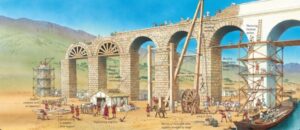
Ancient and Classical Foundations (c. 3000 BCE – 500 CE)
Early civilizations built their understanding of water around necessity. Egyptians tracked Nile flood cycles using “nilometers” as early as 3000 BCE, essential for agricultural planning and taxation. Mesopotamian, Indus Valley, and Chinese civilizations developed irrigation and flood-control systems based on empirical observation rather than theory.
Greek philosophers made the first attempts at theoretical explanations. Thales of Miletus (c. 600 BCE) proposed water as the fundamental substance of nature. Plato and Aristotle theorized about the hydrologic cycle, though Aristotle incorrectly believed rainfall alone couldn’t account for river flow, proposing that water condensed within vast underground caverns.
Romans excelled at hydraulic engineering — aqueducts, sewers (like Rome’s Cloaca Maxima), and distribution systems — though again this was applied engineering more than theoretical science.
The Renaissance Turn Toward Empiricism (1400s–1600s)
- Leonardo da Vinci (1452–1519) made careful observations of water flow, turbulence, and erosion, sketching river currents and hypothesizing about the water cycle with unusual accuracy for his time.
- Bernard Palissy (c. 1580) is often credited as one of the first to correctly argue, in print, that rivers and springs originate from rainfall infiltration rather than seawater seeping through hidden channels.
- Pierre Perrault and Edme Mariotte (1600s) conducted the first quantitative studies of the Seine River basin, measuring rainfall and comparing it to river discharge — demonstrating rainfall was sufficient to sustain river flow. This is often considered the birth of hydrology as a measurement-based science.
- Edmond Halley (of comet fame) measured evaporation rates from the Mediterranean Sea and argued they could account for the flow of rivers feeding it, closing the loop on the hydrologic cycle conceptually.
The Emergence of Quantitative Hydraulics (1700s–1800s)
This period saw hydrology merge with emerging physics and fluid mechanics:
- Daniel Bernoulli (1738) formulated principles of fluid energy conservation (Bernoulli’s principle), foundational to hydraulics.
- Henry Darcy (1856) developed Darcy’s Law, describing flow through porous media — the cornerstone of modern groundwater hydrology, discovered while studying water filtration for the city of Dijon, France.
- Robert Manning (1889) developed the Manning equation for open-channel flow, still widely used today.
Formalization as a Scientific Discipline (Late 1800s–1900s)
- The U.S. Geological Survey established a hydrographic branch in 1894, marking institutional recognition of hydrology as a field requiring dedicated study.
- Statistical and probabilistic methods entered hydrology in the early 20th century for flood frequency analysis and design of infrastructure (dams, levees).
- World War II and postwar development accelerated hydrology through large-scale water projects, spurring advances in reservoir engineering, watershed modeling, and hydrologic forecasting.
- The mid-20th century saw the rise of systems-based and computational approaches — the unit hydrograph method (Sherman, 1932), rainfall-runoff modeling, and eventually digital computer simulation of watersheds.
Modern Era (1960s–Present)
- Remote sensing and satellite technology (from the 1970s onward) enabled large-scale monitoring of precipitation, soil moisture, snowpack, and groundwater (e.g., NASA’s GRACE mission for groundwater depletion tracking).
- Geographic Information Systems (GIS) transformed watershed analysis and modeling from the 1980s–90s.
- Climate change science has reshaped hydrology since the 1990s, integrating it closely with atmospheric science, ecology, and long-term water resource planning.
- Contemporary hydrology is highly interdisciplinary, encompassing ecohydrology, isotope hydrology, urban hydrology, and hydroinformatics (machine learning applied to water systems).