
The hydrologic cycle (or water cycle) is the continuous natural process by which water moves through Earth’s atmosphere, land, and oceans. It begins with evaporation, where heat from the sun turns liquid water from oceans, rivers, and lakes into water vapor, while transpiration adds moisture from plants. This vapor rises and cools in the atmosphere, undergoing condensation to form clouds. When these water droplets become heavy enough, they fall back to Earth as precipitation (rain, snow, sleet, or hail). Once on the ground, this water either infiltrates the soil to become groundwater, runs off across the surface into streams and rivers, or collects in bodies of water, eventually making its way back to the oceans—completing the cycle and allowing the process to begin again.
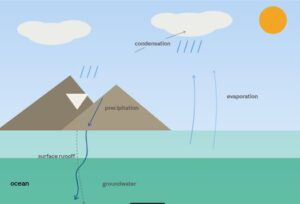
The cycle runs in four main stages, endlessly repeating:
01. Evaporation/Transpiration
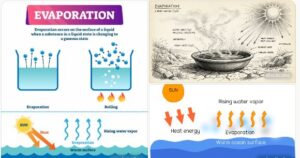
Evaporation or transpiration is the stage where liquid water turns into water vapor and enters the atmosphere. Here’s how it actually works:
The process
Water molecules are always moving, and some near the surface pick up enough energy (mostly from solar radiation) to break free from the liquid and escape as gas. This happens constantly at the surface of oceans, lakes, rivers, and soil — even without boiling, since it only takes a fraction of the molecules to have enough energy to escape, not the whole body of water.
What controls the rate
A few factors speed evaporation up or slow it down:
- Temperature – warmer water and air mean more molecules have enough energy to escape
- Humidity – drier air can “hold” more vapor, so evaporation is faster when the surrounding air isn’t already saturated
- Wind – moving air carries evaporated vapor away from the surface, preventing the air right above the water from becoming saturated and slowing things down
- Surface area – more exposed water surface means more evaporation (this is why oceans, which cover about 70% of Earth’s surface, contribute the vast majority of the vapor entering the cycle)
Where it happens
The ocean is the dominant source, but evaporation also happens from lakes, rivers, moist soil, and even snow and ice (called sublimation, when ice turns directly to vapor). Plants add to this through transpiration — water drawn up through roots and released as vapor through leaves. Combined, evaporation and transpiration are often referred to together as evapotranspiration.
What happens next
Once water vapor rises into the atmosphere, it cools as it moves to higher altitudes (temperature drops with elevation). That cooling is what triggers condensation — the next stage, where vapor turns back into visible droplets, forming clouds.
02. Condensation
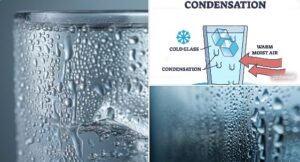
Condensation is the stage where water vapor turns back into liquid (or ice), and it’s essentially the reverse of evaporation.
The process
As water vapor rises from the surface, it moves into cooler, higher parts of the atmosphere. Air temperature drops with altitude, and cooler air can hold less water vapor than warm air. Once the air reaches its dew point — the temperature at which it becomes saturated — the vapor can no longer stay as gas and starts converting back into tiny liquid droplets (or ice crystals, if it’s cold enough).
Why it needs a surface to condense on
Water vapor doesn’t just condense in empty air — the droplets form around microscopic particles floating in the atmosphere called condensation nuclei. These can be dust, sea salt, pollen, smoke, or pollution particles. Without something for the vapor to cling to, condensation is much harder to trigger, even in saturated air.
How clouds form
Billions of these tiny droplets (each far too small and light to fall) cluster together, and that visible cluster is what we see as a cloud. The droplets stay suspended because they’re so small that air currents easily keep them aloft.
What determines the type of cloud
- Altitude – high clouds are often ice crystals (it’s cold enough up there), low clouds are usually liquid droplets
- Air movement – rising air (like over mountains, or warm air masses) cools and condenses vapor faster, often producing puffier clouds; calmer conditions tend to produce flatter, layered clouds
- Temperature – the exact temperature at condensation determines whether it forms liquid droplets or ice
What happens next
Inside the cloud, droplets collide and merge with each other, growing larger over time. Once they’re heavy enough that rising air currents can no longer keep them suspended, gravity takes over — and that’s what triggers precipitation, the next stage of the cycle.
03. Precipitation
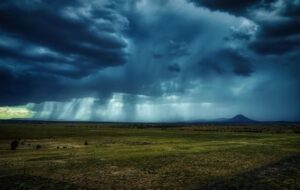
Precipitation is the stage where water in clouds finally falls back to Earth’s surface, releasing the water that evaporation and condensation moved into the atmosphere.
How droplets grow large enough to fall
Cloud droplets start out microscopic — far too small and light to overcome the updrafts holding them aloft. Two main processes make them grow:
- Collision-coalescence – droplets bump into each other as they drift within the cloud and merge into larger drops. This is the dominant process in warm clouds (typically over tropical and temperate oceans).
- The ice-crystal process – in colder clouds, ice crystals grow by pulling in water vapor faster than surrounding liquid droplets (since ice attracts vapor more readily at the same temperature). The crystals grow, sometimes merging with other crystals or collecting supercooled droplets, until they’re heavy enough to fall.
Once a droplet or crystal outweighs the updraft holding it up, gravity pulls it down.
What form it takes when it lands
The form precipitation takes depends on the temperature of the air it falls through, not just the temperature inside the cloud:
- Rain – liquid droplets that stay liquid all the way down
- Snow – ice crystals that fall through air cold enough (near or below freezing) that they never melt
- Sleet – snow that partially melts, then refreezes into ice pellets after passing back through a colder layer
- Freezing rain – rain that stays liquid until it hits a surface at or below freezing, then freezes on contact
- Hail – ice that forms in strong thunderstorm updrafts, where it gets carried up and down repeatedly, adding layers of ice each time, until it’s heavy enough to fall despite the strong updraft
Where it falls
Not all precipitation falls where it evaporated — winds can carry moisture-laden air thousands of kilometers before it condenses and falls. Mountain ranges play a big role here too: as air is forced upward over terrain, it cools and often triggers heavier precipitation on the windward side, leaving the opposite side much drier (a “rain shadow”).
What happens next
Once precipitation reaches the ground, it either soaks into the soil, runs off into streams and rivers, or — if temperatures are cold enough — accumulates as snow or ice. That movement of water across and through the land is the collection stage, the final leg of the cycle before it returns to the ocean and starts again.
04. Collection/Runoff/Infiltration
Runoff and infiltration are the two paths water can take once precipitation hits the ground — and which path it follows determines how quickly (or slowly) that water makes its way back to the ocean.
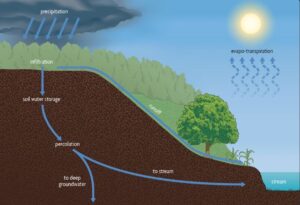
Infiltration
Infiltration is when water soaks into the soil rather than flowing over it. Once underground, it moves through pore spaces between soil particles and rock, pulled by gravity.
- Some of it stays in the upper soil layers, where plant roots absorb it and eventually release it back to the atmosphere through transpiration.
- The rest continues sinking until it reaches the water table — the upper boundary of saturated ground — and becomes groundwater, stored in underground reservoirs called aquifers.
- Groundwater doesn’t sit still. It slowly flows through rock and soil (sometimes over years, decades, or longer) until it seeps out into rivers, lakes, wetlands, or directly into the ocean.
What controls how much water infiltrates
- Soil type – sandy soil has larger pores and lets water infiltrate quickly; clay-heavy soil is dense and infiltrates slowly
- Vegetation – plant roots and leaf litter create channels and slow water down, giving it more time to soak in
- Slope – flatter land gives water more time to infiltrate; steep terrain sheds it faster
- Soil saturation – already-wet soil (from a previous storm, for example) can’t absorb much more, so additional rain is more likely to run off
- Surface type – pavement, rock, and compacted ground are largely impermeable, forcing water to run off instead of soaking in
Runoff
Runoff is water that doesn’t infiltrate and instead flows over the land surface, pulled downhill by gravity. It starts as thin sheets of water, then concentrates into small channels, which merge into streams, then rivers, gradually carrying water toward larger bodies of water and eventually the ocean.
Runoff also does mechanical work along the way — it’s a major driver of erosion, carrying sediment, nutrients, and pollutants downstream, which is why runoff quality is a big concern in urban and agricultural areas.
The balance between the two
Infiltration and runoff are essentially competing for the same water, and the split between them shapes a landscape’s whole hydrology. Heavy urbanization (roads, roofs, parking lots) drastically reduces infiltration and increases runoff, which is part of why cities are more prone to flash flooding than natural landscapes during heavy rain.
Closing the loop
Whether water takes the slow underground route or the faster surface route, both eventually reach rivers, lakes, or the ocean — completing the cycle. From there, solar energy takes over again, evaporation begins anew, and the cycle repeats indefinitely.
Related Posts
- Stages of Valley Development
- Hydrologic Cycle
- Geomorphology
- What is Physical Geography
- Impact of Disasters on Ecosystem
- Theories About the Origin of Earth
- Pacific Ring of Fire