Types of Disasters
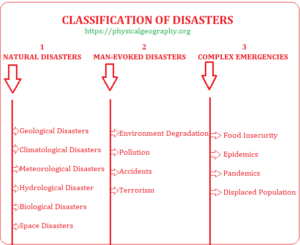
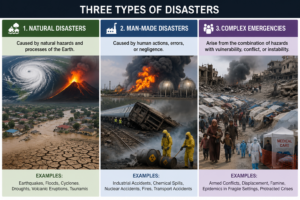
Disasters can be categorised based on their causes. Some disasters are merely caused by natural hazards and are known as “Natural Disasters”, while others are triggered by human activities and are known as “man-made disasters”. But there are some other types of disaster, which are not caused by either of the above stimuli, but rather occur in the aftermath of a pre-existing disaster. Such disasters are known as the “Complex Emergencies”. Here we discuss all three types of disasters in detail.
01. Natural Disasters
Natural disasters can be defined as a natural event and hazards that occurs slowly or rapidly and causes immediate widespread devastation to human health (leading to death and suffering). Some meteorological phenomena, such as rainfall, hailstorms, and dust storms, can also turn into natural disasters when they occur above the average limit. These disasters are mainly characterised by various factors such as their intensity or magnitude, area of the range, duration, speed of onset, etc. Natural resources are also affected by natural disasters. They often cause destruction on a mass level.
Such disasters harm humans and other living species. For example, a natural disaster like a wildfire destroys the environment and causes damage to animal habitats. Also, it damages natural resources and property. Besides, some natural disasters may also be caused by various anthropogenic activities. For example, deforestation, mining, and agricultural activities can trigger landslides. However, they are classified in the category of natural disasters.
Climatologically Disasters
Climatologically, disasters refer to immediate and violent changes in the Earth’s environment related to or caused by the Earth’s atmosphere. It is a hazard mainly caused by long-lived/micro to macro-scale processes in the spectrum from intra-seasonal to multi-decadal climate variability. Moreover, these types of disasters can last from minutes to days. They are further classified as Extreme Temperature and Wildfire. Extreme Temperature events are identified as cold waves, heat waves, and severe winter situations (e.g., icing, avalanches, snow pressure, freezing rain, etc.). Besides, wildfire is identified as the forest fires and land fires (fires due to grass, scrub, etc.).
Meteorological Disasters
Meteorological disasters refer to events that are caused by extreme weather conditions, such as rain, snowfall, or drought. Disasters of this type usually affect the Earth’s atmosphere and the causes of climate. Besides, these disasters are very destructive to the environment and can wreak havoc on many lives, including various species. Some common examples of meteorological disasters are tornadoes, hailstorms, and hurricanes.
Biological Disasters
Biological disasters refer to natural and unfortunate events that can cause diseases, disabilities, or even deaths at an average to a larger rate of various species, including humans and plants. Biological disasters are defined as catastrophic scenarios caused by living or nonliving organisms that cause large-scale severe diseases, viruses, or infections in plants, humans, and other species. These disasters are usually caused by micro-organisms such as
infectious bacteria, toxins, viruses, etc. Some common examples of biological disasters include animal plagues and insect-borne diseases.
Space Disasters
Space disasters are different types of disasters. These usually involve natural actions in space, such as solar flares, airburst events, and impact events. At least once, the impact events have occurred in the history of around 4.5 billion years of the Earth. It is also said that it caused the extinction of all non-avian dinosaurs several million years ago. Solar flares are defined as the sudden release of extremely large amounts of solar radiation by the sun. Airburst events are observed as the enormous energetic explosions of rays (e.g., gamma rays) in distant galaxies. If such an event occurs again today, it may result in the mass extinction of many species, including humans.
02. Man-made Disaster
Disasters can also be caused by humans, either directly or indirectly. Human-made disasters are defined as the events generated by humans primarily in, or close to, human settlements. Such events typically cause environmental or technological emergencies. Human-made disasters have elements of human intent, negligence, or error that involve the human-made system’s failure. Additionally, sometimes disturbances in natural resources also lead to human-made disasters. Some of the most common examples of human-made disasters include terrorism, large-scale crime or mass violence incidents, war, arson, civil disorder, biological/chemical threat, Reduction in consumption resources, etc.
Some most common types of human-made or technological disasters are discussed below:
Environment Degradation
Environmental degradation is a type of disaster involving over-consumption of natural resources, reducing the environment’s ability to meet social and ecological needs. This ultimately reduces the effectiveness of ecosystem services, resulting in the mitigation of floods and landslides. In turn, the risk of natural disasters increases.
Pollution
Pollution is another type of human-made disaster. Although it does not show any direct symptoms, it affects natural resources and living organisms. This also reduces the environment’s quality and further decreases the environment’s ability to balance ecological needs. From day to day, pollution reaches significantly higher levels due to humans’ large number of waste. This leads to increased risks of disasters. Besides, when disasters occur, many of them subsequently pollute and degrade the environment.
Terrorism
Terrorism is a type of human-made disaster and is defined as incidents in which terrorists use force or violence against people or property, violating criminal laws for purposes such as threats, rebellion, or ransom. Terrorism aims to create unrest within the country and spread panic among the people. Acts of terrorism typically include intimidation, murder, bombing, kidnapping, hijacking, and even cyber-attacks (obtaining intelligence and security information). Terrorists can also use chemical and biological weapons to target people at public events, gatherings and landmarks.
Accidents
Accidents can sometimes take the form of a disaster. It usually involves accidental events in which loss of life and material is measured extensively. It includes industrial, technical, and transportation-related accidents during the production, use, or transportation of hazardous materials.
03. Complex Emergencies
Some disasters can occur due to the impact of many disasters. Such disasters are usually classified under complex emergencies. It is generally defined as the consequences of natural and human-made disasters. In particular, complex emergencies can include the breakdown of authority, attacks on strategic installations, looting, increasing rampant crimes, many other conflict situations, or even wars.
The following are common characteristics for identifying complex emergencies:
- Loss of many life
- Extensive violence
- Extreme damage to economies and societies
- Displacements of populations
- Increased security for humanitarian relief workers
- Large-scale humanitarian aid is required by various agencies
- Need for political and military barriers that affect or prevent humanitarian aid
Some of the most common types of complex emergencies that fall under the category of disasters are discussed below:
Food Insecurity
Food insecurity is usually defined as a secondary type of disaster. It is a threat that primarily involves incidents that cause damage to food stores and food systems. For example, natural disasters such as floods and droughts can damage agricultural infrastructure and stored food. Unexpected climate changes can also affect people’s food sources. Because people need to consume adequate, healthy, and nutritious food at certain times of the day to live a healthy life, food insecurity leads to problems and other uncertainties. Sometimes, it can also be due to human actions, such as an unsuccessful experiment on agriculture.
Epidemics and Pandemics
The epidemic primarily involves the devastating effects of disasters caused by any disease, disability, or death of people in a particular area or community. Besides, pandemics include disasters that affect a large extent, even the entire country or the world. For example, the recent coronavirus disease has been declared a pandemic by the WHO (World Health Organisation). Both these disasters can be caused by nature or humans.
Displaced Populations
The displaced population includes people who have had to leave their residences due to disasters/ technical/ intentional incidents. People can be from the same country or refugees (people from other countries or opposite borders). This can lead to a specific emergency as there will be uncertainties to meet the basic structural needs of livelihoods. It can force people to commit crimes and other conflicts.