
Characteristics of a Disaster
In order to be able to identify that a situation is a disaster, the following characteristics must
be eminent and must seem to resonate with the events leading to the situation:
- It is an extra-ordinary event
- Usually occurs because of one of the danger sources, whether caused by nature or
human action. Seriously and substantially impact the most vulnerable groups - Results in serious imbalance in the community functions
- Results in significant losses in human lives, materials and environment
- Exceeds the ability of an affected community to cope with using its own resources
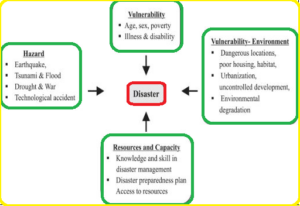
01. Hazards
There are two basic types of Hazards: (i) Natural Hazards, (ii) Man-Made Hazards.
(i). Natural Hazards
These hazards are caused by a natural process. Examples of some
Natural hazards are:
- Earthquakes: An earthquake is a severe trembling of earth crust due to seismic waves triggered by tectonic movement, volcanic eruption, and faulting. An earthquake of severe intensity causes destruction to the property and threatens human, animal and plant lives.
- Volcanic Eruptions: Ashes and different toxic gases are expelled through volcanoes
from deep inside the earth - Droughts: A part of a land suffers from lack of rain during specific period of time
which causes severe damage to the crops, soil, animals and people also. - Tsunamis: Very large waves, which caused by an Earthquake, Volcanic eruptions
smashes into a shore.
(ii). Man-Made Hazards
These hazards are created by humans. Examples of some Man-Made
hazards are:
- Global Warming: Projected increases in the Earth’s atmosphere’s average
temperature. In the 20th century the Earth’s average temperature rose about 0.6
degree Celsius. - Crime: It is a kind of Sociological hazard. Crime is a breach of laws and rules. For
example Breach of contract. - Industrial Hazard: It is a kind of Technological hazard. Industrial hazards often
have an environmental impact. For example, the Bhopal Disaster (the worst industrial
disaster to date)
02. Vulnerability and Risk
i. Vulnerability
Susceptibility of a person, group or society to physical or emotional injury. Or Person or group liable to injury. As far as Hazards and Disasters are concern, the concept of Vulnerability is to link the relationship that people have with their environment to social forces and institutions and the cultural values that sustain them.
Vulnerability = (Exposure ) + (Resistance) + (Resilience) With:
Exposure: Exposure of property and population to the risk
Resistance: Measures taken to prevent, avoid or reduce loss
Resilience: Ability to recover to the prior state or achieve desired post-disaster state
ii. Risk
Occurrence probability of a hazard that triggers a disaster with an undesirable outcome. Risk involves an exposure to a chance injury or loss. Risk is generally described in terms of probability. Risk can also be defined as the probability of a loss. Risk depends on three elements:
• Hazard
• Vulnerability
• Exposure
The different types of vulnerability
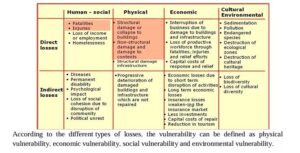
In the table below, four different types of vulnerability have been identified: Human-social, Physical, Economic and Environmental and their associated direct and indirect losses. The table gives examples of types of losses. The ones indicated in red are those that are most frequently evaluated.
(i). Physical Vulnerability
meaning the potential for physical impact on the physical
environment – which can be expressed as elements-at-risk (EaR). The degree of loss
to a given EaR or set of EaR resulting from the occurrence of a natural phenomenon
of a given magnitude and expressed on a scale from 0 (no damage) to 1 (total
damage”.
(ii). Economic vulnerability
The potential impacts of hazards on economic assets and processes (i.e. business interruption, secondary effects such as increased poverty and job loss) Vulnerability of different economic sectors.
(iii). Social vulnerability
The potential impacts of events on groups such as the
poor, single-parent households, pregnant or lactating women, the handicapped,
children, and the elderly; consider public awareness of risk, the ability of groups to self-cope
with catastrophes, and the status of institutional structures designed to help them cope.
(iv). Environmental vulnerability
The potential impacts of events on the environment (flora, fauna, ecosystems, biodiversity).
03. Resources and Capacity
Resources are those available resources which can be used to fight the disaster to limit its destruction, and capacity means the ability of the community and authority to cope with the disaster and overcome the difficult situation while utilising the available resources.