
Introduction to Disasters
Disaster is an extremely fundamental phenomenon in human history. Disaster is a sudden, calamitous, and horrific event that causes great damage and destruction and poses a risk to human life and property. It occurs when a hazardous event overwhelms a community’s ability to cope, resulting in severe human, material, economic, or environmental losses that require external assistance. For an event to be disastrous, it includes two elements;
- The scale of destruction exceeds local resources, making it impossible for the affected community to manage without national or international aid.
- It is caused by the intersection of a dangerous physical event (a hazard) and a vulnerable population (e.g., inadequate planning or exposed infrastructure).
Types of Disasters
Disasters are generally grouped into three categories;
01. Natural Disasters/Calamities
Natural Disasters are those which are caused by natural forces, like floods, storms, earthquakes, cyclones, tsunamis, volcanoes, landslides, heat waves, and droughts, etc. It also includes submarine landslides and wildfires. A natural disaster has a very harmful impact on society and the community. Additional natural hazards include blizzards, dust storms, firestorms, hail, ice storms, sinkholes, thunderstorms, and tornadoes. Loss of life and damage of properties occur on mass level, still it typically causes economic loss. The severity of the damage depends on the unpreparedness of people for disasters, the vulnerability of the buildings, and other infrastructure.
To reduce the destruction to a reasonable extent, a community must be well acquainted with the given country information, including maps, disaster history, current population and economic data, available disaster management plans, development plans, and disaster organisation, and analyse information about hazards, vulnerability and development. The accurate information and knowledge help to identify opportunities or situations where prevention, mitigation and preparedness measures might be applied to reduce risk and improve response.
Scholars have argued that the term “natural disaster” is unsuitable and should be abandoned. Instead, the simpler term disaster could be used. Actually, a hazard (natural or man-made) is said to be disastrous when it hits a vulnerable community or area. It means that hazards themselves are not disastrous, but the vulnerability of a region or community.
02. Man-Made Disasters
A man-made disaster is a catastrophic event caused by human intent, negligence, or error rather than natural hazards. These events—such as industrial explosions, oil spills, chemical leaks, structural collapses, and acts of terrorism—can cause severe loss of life, environmental damage, and economic disruption. Man-made disasters are generally divided into broad categories based on their origin and the systems that failed:
- Technological & Industrial: Failures of large-scale infrastructure, systems, or equipment. These include nuclear reactor meltdowns (e.g., Chernobyl), dam and levee failures, and major structural collapses.
- Chemical, Biological, Radiological, and Nuclear (CBRN): Accidental or intentional release of hazardous materials, such as toxic gas leaks or radioactive fallout. In past, we can find many instances of the intentional spread of a contagious disease for warfare.
- Environmental & Ecological: Long-term or catastrophic environmental harm caused by human activity, such as massive oil spills or widespread land degradation.
Some notable historical man-made disasters are the Bhopal Gas Tragedy (1984), Chernobyl Disaster (1986), and Deepwater Horizon (2010).
Disaster Risk Management
Disaster management refers to the systems we use to deal with human, property, economic or environmental resources against disasters. It is how we prepare, deal, respond, and learn from disasters and their effects. Disasters management mainly aims to:
- Prevention of the threat of disasters
- Readiness to deal with disasters
- Saving the lives of all living organisms
- Minimise suffering to the maximum possible extent
- Protect and restore livelihoods
- Minimise the risks and uncertainties to societies affected by disasters
Proper planning and mitigation measures can play a leading role in risk-prone areas to prevent or mitigate the worst effects of many disasters, including cyclones, earthquakes, and floods. Besides, many disasters are predictable before arrival, so we can prepare ourselves to reduce the damage caused by them.
Cycle of Disaster Risk Management
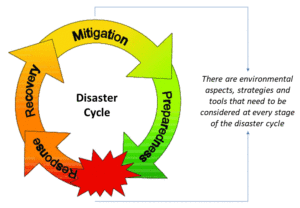
The cycle of disaster management is a continuous framwork designed to minimise human and economic losses. It encompasses four interconnected phases:
01. Mitigation (Risk Reduction)
Mitigation or Risk Reduction is a pre-disaster strategy, which includes a wide variety of measures taken before an event occurs that will prevent illness, injury, and death and limit the loss of property. Taking crucial initiatives to mitigate potential hazards has gained increasing favour in disaster preparedness circles, particularly in the international arena, where disaster risk reduction (DRR) and disaster risk management (DRM) are much prioritised over efforts focused simply on disaster event response. It is a preemptive preparedness for the future risks of a disaster. These are long-term policies and strategies, that are planned to diminish the vulnerability of the disaster-prone area and community. Setting and implementing the building codes, clearing the way of the flesh floods, growing tree beside the river banks, engineered planning to reduce the risk of landslides, and lessen the chances of firebreak in jungles, etc., are those important steps, which help reduce the potency of destruction of natural hazards. The absolutely stunning loss of life, illnesses, injury, psychological impact, displacement from home and community, and social and financial consequences of a disaster, coupled with its disproportionate impact on the already disadvantaged, make it imperative to fully implement the best principles and practices of disaster mitigation. These principles and practices fall into two types:
- Disaster Risk Reduction (DRR) aims to reduce the damage caused by natural hazards like earthquakes, floods, droughts, and cyclones, through the ethic of prevention.
- Disaster Risk Management (DRM) includes management activities that address and seek to correct or reduce disaster risks that are already present.
Hyogo Framework for Action
The Hyogo Framework for Action offers guiding principles, priorities for action, and practical means to achieve disaster resilience for vulnerable communities. Priorities for action include the following:
-
- Ensure that DRR is a national and local priority with a strong institutional basis for implementation
- Identify, assess, and monitor disaster risks and enhance early warning
- Use knowledge, innovation, and education to build a culture of safety and resilience at all levels
- Reduce the underlying risk factors
- Strengthen disaster preparedness for effective response at all levels
Although the primary emphasis on the Hyogo Framework is natural disasters, the processes discussed and framework for community resiliency and partnerships have application to all types of hazard responses.
02. Preparedness (Planning)
Like the strategy of mitigation, preparedness is also a pre-disaster planning, which is meant for enhancing the resilience of the community to face the disaster. The objective of well-preparedness is to minimise loss of life, illnesses, injury, psychological impact, displacement from home and community, and social and financial consequences of a disaster to a stunning extent.
- Making a plan to choose a primary spot right outside your home in case of fire, and a secondary location outside your neighbourhood if you are forced to evacuate.
- Memorising or writing down crucial phone numbers. Pick an out-of-town relative or friend as a family check-in contact, as long-distance lines often work better during local emergencies.
- Mapping out multiple ways to leave your area. Identify local emergency shelters or make plans to stay with out-of-area friends or family.
- Securing digital or physical copies of vital records (ID cards, insurance policies, medical records, property deeds) in a waterproof, fireproof container or on a secure cloud drive.
- Gathering enough supplies to be entirely self-sufficient for at least 72 hours. Your kit should include food, water, communication devices, first aid and other personal items.
03. Response (Emergency Action)
This is a post-disaster strategy, and the sole objective of this phase of the strategy is to protect lives and precious properties. An effective disaster response requires immediate execution of life-saving actions to manage a crisis and minimise its impact. The standard sequence of emergency actions includes securing personal safety, alerting authorities, evacuating if necessary, and providing first aid.
An effective disaster response focuses on quick and organised actions to control the situation and help affected people.
- Secure Personal Safety
- First, ensure your own safety.
- Move away from danger and protect yourself from further harm.
- Alert Authorities
- Inform emergency services, police, firefighters, or disaster management agencies.
- This helps professional responders reach the affected area quickly.
- Evacuate if Necessary
- Leave the dangerous area if instructed by authorities.
- Move to a safe location or emergency shelter.
- Provide First Aid
- Give immediate medical assistance to injured people until professional medical help arrives.
- This can save lives and prevent injuries from worsening.
04. Recovery (Recovery and Rebuilding to Normal)
It is the most crucial phase of disaster risk management, which involves both short and long-term processes of returning the community to a state of normalcy or an improved state of safety. Restoring essential infrastructure (electricity, roads, water), debris clearing, financial assistance, and long-term psychological and economic support. Things that need to be done by the authorities by engaging the affected community are;
– Reconstruction of disaster-resistant infrastructure.
– Planning an appropriate use of land.
– Providing the affected community with livelihood support.
– Industrial rehabilitation planning.
To make these measures effective, an active role on behalf of the authorities and community engagement is significantly important. Disaster displaces communities, makes people unemployed, compels them to evacuate their homes, deprived of power supply, drives food shortages, increases the risk of out break of contagious diseases like cholera, which may take the form of an epidemic, and the most horrible is deprived of the shelter. In these circumstance, very hard struggle and courage is needed to rehablitate. Aid from the authorities, international aiding agencies, and especially from the communities not affected by the calamity, has pivotal importance in this regard.