
Financial Management of Disaster Impacts is a strategic framework focused on ensuring that governments, businesses, and individuals have the immediate liquidity and long-term funding necessary to respond to, recover from, and adapt to catastrophic events.
When a disaster strikes, the immediate economic shock can derail fiscal stability. Managing this risk requires moving from a reactive approach (relying on post-disaster aid) to a proactive strategy (pre-arranging financial instruments).
One of the most widely recognised, gold-standard examples of a financial layering model successfully reducing disaster effects is “Mexico’s National Disaster Fund (FONDEN)”. FONDEN was designed to transition Mexico away from relying on ad-hoc emergency budget reallocations or international donor charity after earthquakes and major hurricanes. By building a highly structured, multi-tiered financial strategy, Mexico successfully minimized the macroeconomic impact of devastating natural hazards.
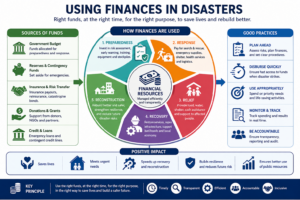
Disaster Risk Financing Layering Model
Financial management of disaster impacts is generally divided into three distinct layers based on a risk-versus-cost analysis:
1. The Bottom Layer: Low Severity / High Frequency
This layer covers routine, localised events that happen almost every year, such as minor seasonal flooding or predictable dry spells. The impact of such incidents is generally very low, but they occur very frequently each year. This is why they can be easily managed, and the impact can be couped by minor finances.
-
The Strategy: Retention. The entity absorbs the financial shock internally because transferring this high-probability risk to third parties would be prohibitively expensive.
-
Financial Instruments: Contingency funds are explicitly set aside in the yearly budget, and funds are dynamically shifted away from non-essential public or corporate projects to immediate relief efforts.
2. The Middle Layer: Moderate Severity / Medium Frequency
This layer accounts for more destructive events that happen every few years or once a decade, such as a severe regional storm or a moderate earthquake.
-
The Strategy: The focus here is securing rapid access to capital without waiting for long loan-approval processes or foreign aid.
-
Financial Instruments:
-
Contingent Credit Lines: Pre-arranged credit facilities with international financial institutions (like the World Bank’s Catastrophe Deferred Drawdown Option, or CAT-DDO). These loans automatically unlock the moment a state of emergency is declared.
-
Regional Risk Pools: Multi-country sovereign insurance pools (like the CCRIF in the Caribbean or ARC in Africa) that spread risk across a geographic region.
-
3. The Top Layer: High Severity / Low Frequency
This layer represents rare, catastrophic “black swan” events—such as massive earthquakes, Category 5 hurricanes, or major pandemics—that can completely derail an economy or a corporation’s balance sheet.
-
The Strategy: Risk Transfer. The potential cost is so immense that it must be offloaded to global capital and reinsurance markets.
-
Financial Instruments:
-
Parametric Insurance: Traditional indemnity insurance takes months to assess damage. Parametric insurance pays out automatically within days based on a pre-agreed physical trigger (e.g., wind speed exceeding 130 mph or an earthquake crossing a specific Richter scale threshold).
-
Catastrophe (Cat) Bonds: Specialized debt instruments. Investors buy the bonds and receive high interest rates. If the catastrophic event occurs, the investor loses their principal, which is immediately transferred to the issuer (the government or company) to fund reconstruction.
-
Why “Layering” is Highly Efficient
Using the layering model is significantly more cost-effective than relying on a single strategy. Financial layering model is significantly important for the following reasons.
-
Minimises the Cost of Capital: Relying exclusively on insurance for small, frequent events is incredibly wasteful due to high premium costs. Conversely, relying only on budget reserves for a massive earthquake would leave an economy entirely bankrupt. Layering ensures you only pay for expensive market insurance when necessary.
-
Optimises Funding Speed: Disasters require different timelines for cash. The bottom and middle layers provide liquidity within days for immediate emergency relief. The top layer provides the massive capital required months later for long-term structural reconstruction.
- Reduces Reliance on Post-Disaster Aid: The financial risk layering model reduces reliance on post-disaster humanitarian aid by moving a country’s disaster response from a reactive (ex-post) approach to a proactive (ex-ante) strategy. Instead of waiting for a disaster to hit and hoping for international charity or emergency loans, governments and organisations use a combination of pre-arranged financial instruments optimised for different levels of disaster frequency and severity.
- Improves Financial Resilience: The financial risk layering model improves financial resilience by ensuring that a country or organization doesn’t rely on a single, fragile source of funding when a disaster strikes. Instead, it builds a structural “financial shield” that matches different financial tools to the frequency and severity of various disasters.