
free web page counters EarthQuakes | A detailed description of the Earthquakes. - Physical Geography

What is an Earthquake?

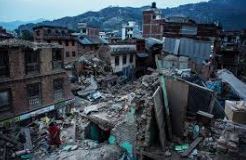
An Earthquake is a sudden trembling and shaking of Earth’s surface caused by the release of a huge amount of energy in lithosphere (crust+solid mantle). The release of energy within the earth’s lithosphere is caused, usually from the slipping of tectonic plates along a fault, creating seismic waves that travel outwards from the source/ focus. The other causes of the earthquakes may be volcanic eruption, faulting, and filling or emptying of aquifers. The energy that causes an earthquake is transferred from the Epicenter to the surface through seismic waves. Earthquakes may be of different intensities, ranging from those so weak they cannot be felt, to those violent enough to propel objects and people into the air, damage critical infrastructure, and wreak destruction across entire cities. The frequency, type, and intensity of the earthquakes experienced at a particular area for a specific period of time is known as the seismic activity of that particular area. The seismicity at a particular location in the Earth is the average rate of seismic energy release per unit volume.

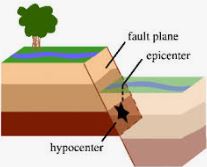
While simplifying the definition, an earthquake is any kind of event on/in the Earth, which generates seismic waves. Moreover, when these seismic waves travel upward to the Earth’s surface bring about shaking and trembling on the surface, which is known as an Earthquake. The point where there is the origin of the Earthquake, is known as Hypocenter or Focus, while the point of Earth surface, which directly above the Hypocenter, is known as Epicenter.


Types of Seismic Wave (Earthquake Waves)

An earthquake generates two types of waves;

  • The body waves, which include primary and secondary waves. These waves penetrate into the body of Earth and travel across the entire body of the Earth.
  • The Surface Wave, which include Love and Raleigh Waves. These waves are unable to penetrate the Earth’s body, and are confined to the surface.

Body Waves

1. P-Waves

P-waves (Primary waves) are the fastest seismic waves, which are compressional in nature, they tend to compress and stretch the ground in the direction of travel (like sound waves). These waves are able to move through solids, liquids, and gases. They rapidly arrive first at seismographs to signal an earthquake.

The distinctive characteristics of the P-waves are:

  • Type: Longitudinal, compressional waves (pressure waves).
  • Motion: Shake the ground back and forth (parallel) to the wave’s direction.
  • Speed: Fastest seismic waves, first to arrive, but less destructive.
  • Medium: Travel through solids, liquids, and gases (unlike S-waves).
  • Significance: Help scientists map Earth’s interior, especially the liquid outer core, by how their speed changes and refracts.

2. S-Waves

S-waves, also known as shear waves, are secondary seismic waves that are longitudinal in nature, and move rock particles perpendicular (up-and-down or side-to-side) to the direction of waves. They cause significant shaking, and bring big devastation after P-waves. They are slower than P-waves and, crucially, can only travel through solids, not liquids or gases, making them vital for mapping Earth’s liquid outer core and interior structure. 

Distinctive Characters of S-waves are:

  • Type of Wave: Transverse wave (particle motion is perpendicular to wave travel).
  • Speed: Slower than P-waves, arriving second at seismographs.
  • Medium: Travel only through solids; cannot pass through liquids or gases. 
  • Motion: Cause shearing (side-to-side or up-and-down) motion in the ground, often more destructive.
  • Earth’s Interior: Their inability to travel through the liquid outer core provides key evidence for its liquid state. 

The secondary waves are significantly important because the “S-wave shadow zone” (areas where they can’t be detected) confirms the liquid outer core. Moreover, the time difference between P-wave and S-wave arrivals helps calculate the distance to an earthquake’s epicenter.

Surface Waves

1. L-Waves:

L-waves, also known as Love waves travel through surface of Earth.  They are powerful seismic waves, and like S-waves, they cause horizontal, and side-to-side shaking of the ground during an earthquake. They are confined to the surface, but cause significant demage to the property, and infrastructure. These waves were discovered by a mathematician A.E.H Love, and thus named after him. They move slower than either type of the body waves, but still faster than the Raleigh Waves. Hence, their energy is concentrated at the Earth’s surface, and travel perpendicular to the wave’s direction with a shearing motion, they cause deformation within the materials that slide past each other.


2. R-Waves

During an earthquake, the R-waves or Rayleigh waves come fourth in speed and third in devastation. These waves cause ground motion in a rolling, elliptical (up-and-down and side-t0-side) motion. They are similar to ocean waves, leading to significant shaking and destruction. They are stronger than P-waves, but weaker than S-waves and L-waves in destruction. They travel along the Earth’s surface after faster P and S body waves, arriving last but often causing the most damage due to their large amplitude and prolonged shaking, hence the name R-wave for Rayleigh. These waves were named after the English physicist “John William Strutt, Lord Rayleigh, who discovered them in 1885.


Causes of Earthquakes

The most common cause of an earthquake is tectonic movement, however there are several other causes of the earthquakes, like volcanic eruption, faulting, land sliding, reservior filling, or human activities like fracking, bomb blasts, drilling, etc. Let have a look at these causes in detail.

01. Earthquakes by Tectonic Movement

The Earth’s crust is cracked, and each cracked shell is know as the tectonic plate. These tectonic plates are continuously moving. Their motion is of three types; the divergent motion (where two plates are moving apart), the convergent motion (where two plates are drifting closer to each other), and the transform motion (where tectonic plates slide horizontally past each other).
1. Convergent plate motion, where paltes collide, is a major cause of earthquakes, geneterating intesnse pressure and friction that builds stress. These plates bear the stress to a described extension. On slipping of the two plates, this stress released, and powerful seismic waves are generated. These seismic waves results in earthquake. About 80% of all earthquakes happen at these colliding boundaries, which can involve oceanic-continental, oceanic-oceanic, or continental-continental plates. 
2. Divergent boundaries cause earthquakes as two plates move apart. The divergent movement creats tension that fractures the brittle crust, forming faults and allowing magma to rise, which further stresses the rock and generates frequent, shallow, and low-magnitude seismic events. These earthquakes happen as the crust stretches, cracks, and adjusts to the spreading motion, often along normal faults and connecting transform faults, releasing energy in small bursts. The earthquakes at Mid-Atlantic Ridge (that splits North America and Eurasia) and the East African Rift (spliting the African Plate) are good examples of earthquakes caused by divergent movement, but these quakes are usually smaller and shallower than those at convergent boundaries, forming new crust as magma rises, with notable examples in the Red Sea Rift and the East Pacific Rise. 

3. The earthquakes are frequent and often more powerful along transform boundaries (also known as transform faults or conservative boundaries) because tectonic plates slide horizontally past one another, building up massive amounts of stress that is suddenly released when the friction is overcome. The process that leads to earthquakes at transform boundaries is explained by the elastic rebound theory. Notable examples of such earthquakes are;

  • San Andreas Fault, USA: The most famous example, where the Pacific Plate slides past the North American Plate, is responsible for California’s significant earthquake hazard.
  • North Anatolian Fault, Turkey: This fault system has produced a sequence of damaging earthquakes throughout the 20th century.
  • Alpine Fault, New Zealand: This major transform fault runs nearly the entire length of New Zealand’s South Island and causes frequent seismic activity. 

Elastic Rebound Theory

Elastic rebound theory explains the mechanism of earthquakes at a transform boundary. A sudden release of built-up stress in the Earth’s crust deforms the rocks elastically (like a stretched rubbler band) under tectonic forces until the friction on a fault line breaks, causing the rocks to snap back to a less strained, original shape, relasing immense energy as seismic waves. This process involves gradual stress accumulation, sudden rupture, and rapid energy release, causing the ground to shake and shift. 

  • Plate Movement & Friction: Tectonic plates move slowly (a few centimeters per year), but their edges are rough and get stuck due to friction.
  • Gradual Stress Buildup: While the fault is “locked,” the plates continue to move, causing stress and strain energy to build up in the adjacent rocks.
  • Sudden Rupture: Eventually, the stress exceeds the strength of the rocks and the frictional force holding them together. The fault suddenly slips, releasing the stored energy as seismic waves. This sudden release causes the ground to shake, which is an earthquake.
  • Seismic Waves: This rupture releases energy as P-waves, S-waves, and surface waves, which propagate outward, causing the ground to shake. 


Leave a Reply

Your email address will not be published. Required fields are marked *