
It is not the Earthquakes that cause casualties and fatalities, but rather the man-made structures, which do not withstand Earthquakes. During an earthquake, the key to protect oneself is “Drop, Cover, and Hold On”. There are several techniques, and preparations which can, no doubt, protect you. You might be indoor, outdoor, or travelling during an earthquake. You have to follow different instruction for each position. If you are fully prepared and follow the given technique, you can escape yourself from the hazardous effects of the earthquake.
How to protect yourself during an earthquake?
If you are indoors
If you are indoors during an earthquake, the safest action is to “Drop, Cover, and Hold On”. Meaning that drop to the ground, cover yourself with something sturdy like table, desk, almira, or shelf, or take cover against an inside wall if there is no furniture, and hold on until shaking stops. Meanwhile, staying away from windows, outside doors, and heavy items that could fall. Do not run outside, as falling debris is a major hazard; wait until the shaking stops completely before evacuating carefully.
If you are outdoors
If you’re outdoors during an earthquake, move to clear and open areas, away from buildings, trees, streetlights, power lines/poles. Like indoors, drop, cover and hold on until the shaing is reduced, as the main danger is falling of debris from structures. The goal is to get away from things that can fall on you and protect yourself from flying objects.
If you are driving
If you notice shaking/trembling due to an earthquake, you must stop your car, and switch off the engine, and apply the parking brakes, as the brakes reduce the risk of turning the car upside-down. Moreover, during an earthquake, pull over to the side of the road away from bridges, transmission lines, under-passes, and other nearby infrastructure. Meanwhile, stay inside the car, and tighten your seat belts until the shaking stops. After the shaking stops, proceed cautiously, watching for road damage and listening to emergency broadcasts for updates.
The earthquake-resistant buildings
Earthquake-resistant buildings aren’t built to be indestructible — they’re built to survive, deform predictably, and protect lives even if some damage occurs. Here’s how engineers achieve that.
Core Philosophy
Traditional buildings are rigid and try to resist earthquake forces head-on, which can cause catastrophic failure. Modern earthquake engineering follows a different philosophy: absorb, dissipate, or redirect seismic energy rather than fight it. The goal, per most building codes, is a hierarchy of performance:
-
- Minor earthquakes: no damage
- Moderate earthquakes: repairable damage
- Major earthquakes: no collapse, occupants can evacuate safely (even if the building is a write-off afterward)
Key Techniques
1. Base Isolation
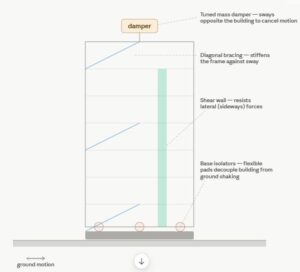
The building sits on flexible bearings (rubber-and-steel pads or sliding surfaces) between the foundation and the superstructure. When the ground shakes violently, the isolators absorb the horizontal movement, so the building above moves much less and more slowly than the ground beneath it. This is one of the most effective techniques and is used in hospitals, government buildings, and landmark structures.
2. Dampers (Shock Absorbers for Buildings)
-
- Viscous dampers: piston-based devices (like car shock absorbers) that convert seismic energy into heat.
- Tuned mass dampers: a large weight (sometimes hundreds of tons) suspended near the top of the building that sways opposite to the building’s motion, canceling out vibration. Taipei 101 famously uses a giant steel ball for this.
- Friction dampers: use controlled sliding friction to dissipate energy.
3. Shear Walls
Reinforced concrete walls placed strategically through a building that resist lateral (sideways) forces, preventing the structure from racking or twisting.
4. Moment-Resisting Frames
Beam-column connections are designed to be rigid and ductile, so the frame flexes and bends without snapping, distributing stress across many joints instead of concentrating it at one weak point.
5. Diagonal Bracing
Steel braces (in X, V, or chevron patterns) form triangles that stiffen a structure’s frame against lateral sway, common in steel-frame buildings.
6. Ductile Materials and “Weak Beam, Strong Column” Design
Engineers deliberately design beams to yield (bend/deform) before columns do. If a column fails, the floors above can collapse (pancake collapse); if a beam yields, the building sags locally but stays standing.
7. Symmetry and Regular Shape
Buildings that are symmetrical and have uniform mass distribution respond to shaking more predictably. Irregular shapes, soft stories (e.g., open ground floors like parking garages), and asymmetric mass concentrations create dangerous torsional (twisting) forces.
8. Foundation Design
On soft or liquefiable soil, deep pile foundations anchor into stable bedrock. Soil-structure interaction is a major part of seismic design — the same building can behave very differently depending on the ground it sits on.
Let’s show you how these pieces fit together structurally.
How It All Comes Together
Real buildings combine several of these techniques depending on seismic risk, height, budget, and soil conditions. A skyscraper in Tokyo might use base isolation plus a tuned mass damper plus moment frames — layered redundancy is standard for high-stakes structures. A smaller residential building in a moderate-risk zone might rely mainly on shear walls, proper rebar detailing, and code-mandated symmetry.
A Few Real-World Examples
Taipei 101: uses a 660-ton tuned mass damper visible to visitors
San Francisco City Hall: retrofitted with base isolators after the 1989 Loma Prieta earthquake
Transamerica Pyramid: its tapered pyramid shape plus a rigid steel frame lowers its center of gravity and reduces sway
Japanese building codes (among the world’s strictest): mandate specific ductility and stiffness ratios, which is a major reason Japan sees far fewer earthquake-related building collapses than countries with similar seismic activity but weaker codes
How to Cope With Casualties During an Earthquake
If you or someone you know has lost people in an earthquake or disaster:
- Grief after disaster often comes with disorientation — on top of loss, there’s disrupted routine, displacement, and ongoing uncertainty (aftershocks, unstable buildings). It’s normal for grief to feel more chaotic than in “ordinary” loss.
- Basic needs come first. Shelter, food, safety, and information reduce the chronic stress that makes grief harder to process.
- Connection matters. Staying near community, family, or familiar people — even briefly — helps regulate the nervous system after trauma.
- Professional support helps. Disaster response usually includes crisis counselors or psychological first aid teams; local Red Cross or equivalent organizations often provide this free of charge.
- It’s okay if grief takes a long time, especially with the added complication of large-scale, sudden loss.
How emergency responders/planners manage mass casualties
This is a distinct field called mass casualty management, with a few core principles:
- Triage — sorting the injured by severity (commonly using color-coded systems: immediate/red, delayed/yellow, minor/green, deceased/black) so limited medical resources go where they save the most lives
- Search and rescue — the first 24–72 hours (“golden window”) are critical for survivors trapped in rubble
- Incident command structure — a clear chain of authority so hospitals, fire, police, and volunteers aren’t working at cross-purposes
- Surge capacity — hospitals activate disaster plans to expand bed capacity, cancel elective procedures, and bring in outside medical teams
- Body identification and family reunification — separate but urgent tracks, often handled by dedicated disaster mortuary teams
- Mental health response — psychological first aid deployed alongside physical medical care, since acute stress reactions are common and treatable early.
Practical Guidance to Handle Casualties
Here’s practical guidance for handling casualties during and immediately after an earthquake:
a. Your safety first
Before helping anyone else, make sure you’re not still in danger. Aftershocks are common and can cause more collapses. Stay away from damaged structures, downed power lines, gas leaks, and unstable rubble unless you’re specifically trained for search and rescue.
b. Immediate response
1. Do a scan before moving people
Don’t rush to pull injured people out unless there’s immediate danger (fire, gas, further collapse). Moving someone with a spinal injury incorrectly can cause paralysis. Only move them if staying put is more dangerous than moving.
2. Basic triage (if multiple injured)
If you’re one of the first responders and there are several casualties, quickly sort by severity:
-
-
- Can they walk and talk? → lower priority, direct them to a safe gathering point
- Breathing but unresponsive, or severe bleeding → highest priority, needs immediate help
- Not breathing → attempt to clear airway and start CPR if trained; otherwise move to those you can help
- No signs of life after reasonable effort, in a mass-casualty situation → responders sometimes have to move on to save others who can still be helped — this is a hard triage reality, not a personal failure
-
3. Control severe bleeding
Apply firm, direct pressure with any clean cloth available. This is often the single most life-saving action a bystander can take before professional help arrives.
4. Don’t move someone with a suspected spinal or head injury unless fire, gas, or collapse risk forces it. If you must move them, try to keep the neck and spine aligned.
5. Keep injured people warm and calm while waiting for help — shock can be as dangerous as the initial injury.
c. Getting help
-
- Call emergency services as soon as lines are working, but expect delays — mass casualty events overwhelm response systems fast.
- Note the number and condition of casualties if you can, to relay to arriving responders.
- If official help hasn’t arrived, community members often become the first line of response — organize by task (search, first aid, gathering supplies) rather than everyone doing everything.
d. Emotional toll
Responding to casualties, especially involving people you know, is traumatic. Acute stress reactions (shaking, numbness, tunnel vision) are normal in the moment — they don’t mean you’re doing it wrong. Afterward, it’s worth talking to someone or accessing crisis counseling if it’s available, even if you feel “fine” at first.