
Global Water Budget
The global water budget is the accounting of Earth’s total water — roughly 1.386 billion km³ — as it is distributed among reservoirs (oceans, ice caps and glaciers, groundwater, lakes, rivers, atmosphere, and living organisms) and continuously cycled between them through processes like evaporation, transpiration, precipitation, runoff, and infiltration; while the total quantity of water on Earth remains essentially constant, it constantly changes form and location, with inputs (such as precipitation) and outputs (such as evaporation and runoff) balancing out over time for any given reservoir or region under natural, long-term conditions.
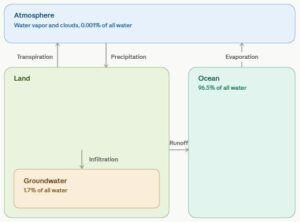
The reservoirs
Total water on Earth: ~1.386 billion km³
- Oceans: ~96.5% of all water — by far the largest reservoir
- Ice caps, glaciers, and permanent snow: ~1.74% — mostly Antarctica and Greenland
- Groundwater: ~1.7% (fresh and saline combined)
- Freshwater lakes: ~0.007%
- Atmosphere: ~0.001%
- Rivers: ~0.0002%
- Biological water (in living things): a tiny fraction
Of all water, only about 2.5% is freshwater, and of that, roughly 68.7% is locked in ice and glaciers, about 30% is groundwater, and less than 1% is in accessible surface freshwater (lakes, rivers, swamps) — meaning surface freshwater is a very small sliver of the total.
The flows (fluxes)
Water constantly moves among reservoirs through the hydrologic cycle:
- Evaporation: from oceans (~86% of global evaporation) and land surfaces
- Transpiration: water released by plants (often combined with evaporation as “evapotranspiration”)
- Precipitation: rain and snow falling over ocean and land
- Runoff: water flowing from land back to the ocean via rivers
- Infiltration: water percolating into soil and groundwater
- Sublimation/deposition: ice/snow to vapour and back
Globally, evaporation and precipitation must balance over long timescales: what evaporates from the ocean and land eventually falls as precipitation somewhere, and land runoff returns the ocean’s deficit. Roughly:
- Ocean: evaporation exceeds precipitation (net loss to atmosphere, made up by river runoff)
- Land: precipitation exceeds evapotranspiration (net gain, balanced by runoff back to oceans)
Why Does the Global Water Budget Matter?
The global water budget matters because it’s the framework for understanding how much usable water actually exists and where it moves — which underpins nearly everything from agriculture to climate policy. Here’s why it’s significant:
1. It reveals how scarce accessible freshwater really is
Even though water covers most of the planet, ~96.5% is saline ocean water and most of the remaining freshwater is locked in ice or deep groundwater. Understanding the budget shows that only a tiny sliver — surface lakes, rivers, and shallow groundwater — is readily usable by humans, which is critical for planning water supply.
2. It helps predict and manage droughts and floods
By tracking the balance of precipitation, evaporation, and runoff in a region, scientists and planners can anticipate water shortages or surpluses, informing reservoir management, irrigation scheduling, and flood defenses.
3. It underpins climate science
The water cycle and the carbon/energy cycle are deeply linked — water vapor is a greenhouse gas, and evaporation transports heat. Monitoring shifts in the water budget (like increased atmospheric moisture or glacier melt) helps track and model climate change.
4. It guides water resource and infrastructure planning
Governments and agencies use water budgets to decide how much water can be sustainably withdrawn from rivers, aquifers, or reservoirs for cities, farming, and industry without depleting the source faster than it’s replenished.
5. It flags unsustainable groundwater use
Many major aquifers (Central Valley, North China Plain, Punjab) are being drained faster than natural recharge replaces them. Budget calculations are what expose this imbalance before wells run dry.
6. It informs ecosystem and biodiversity protection
Wetlands, rivers, and lakes depend on stable water inflows and outflows. Disruptions to the local water budget can collapse habitats that depend on specific water levels or seasonal flow patterns.
7. It supports long-term planning under climate change
As warming alters evaporation rates, precipitation patterns, and ice melt, the global water budget is shifting — understanding these baseline dynamics is essential for adapting agriculture, urban planning, and disaster preparedness to a changing water cycle.
Factors That Are Affecting The Global Water Budget
Several interconnected factors are altering the global water budget — some natural, but increasingly dominated by human activity. Here’s a breakdown:
1. Climate Change
The biggest disruptor of the water budget today is climate change. It influence the global water budget in several ways;
- Warmer atmosphere holds more moisture — about 7% more water vapor per °C of warming (Clausius-Clapeyron relationship), intensifying both evaporation and precipitation extremes
- Glacier and ice sheet melt — Greenland, Antarctica, and mountain glaciers are losing mass, shifting water from long-term ice storage into oceans and rivers
- Shifting precipitation patterns — wet regions tend to get wetter, dry regions drier; monsoon timing and intensity are changing
- Sea level rise — meltwater and thermal expansion of oceans increase the ocean reservoir at ice’s expense
- More frequent extremes — heavier rainfall events alternating with longer droughts, disrupting the steady balance of runoff and infiltration
2. Groundwater Depletion
Humans are pumping groundwater faster than natural recharge can replace it, especially for irrigation.
- Major aquifers like the Central Valley (California), North China Plain, and India’s Punjab region are being drawn down at unsustainable rates
- This permanently reduces a reservoir that took centuries to millennia to fill
3. Land Use Change
- Deforestation reduces transpiration and can alter regional rainfall patterns (the Amazon, for instance, generates much of its own rainfall through forest transpiration)
- Urbanization increases impervious surfaces (concrete, asphalt), reducing infiltration and increasing rapid runoff, which lowers groundwater recharge and raises flood risk
- Agricultural expansion changes evapotranspiration rates and often requires large-scale irrigation, pulling water from rivers and aquifers
4. Damming and River Diversion
- Large dams and reservoirs alter natural river flow, evaporation rates (large reservoir surfaces lose significant water to evaporation), and downstream water availability
- Diversion for irrigation or urban supply can dry up terminal lakes and wetlands (the Aral Sea is a stark example)
5. Population Growth and Water Demand
- Rising demand for drinking water, sanitation, agriculture, and industry increases withdrawal from both surface and groundwater sources
- Growing demand often outpaces the natural replenishment rate in many regions
6. Pollution and Water Quality Degradation
- Contaminated water becomes unusable even if physically present, effectively shrinking the “usable” portion of the budget
- Saltwater intrusion into coastal aquifers (worsened by both over-pumping and sea level rise) reduces freshwater availability
7. Industrial and Agricultural Water Use
- Irrigation accounts for the largest share of global freshwater withdrawal, and inefficient irrigation methods waste significant volumes through evaporation and runoff
- Industrial processes consume and often contaminate large amounts of water
8. Natural Variability
- El Niño/La Niña (ENSO) cycles shift precipitation and drought patterns globally
- Volcanic activity can temporarily cool the atmosphere and alter evaporation/precipitation patterns
- Solar cycles have minor, longer-term effects on global temperature and thus the water cycle
Most Read Articles:
- Four Stages of the Valley Development
- What is Physical Geography
- Theory of Continental Drift
- Definition and Scope of Geomorphology
- Types of Geomorphology
- Evolution of Geomorphological Thoughts
- Methods and Approaches to the Study of Landforms
- Trends and Developments in Geomorphology
- Geomorphic Models