
What is The Ring of Fire?
The ring of fire, also known as the Pacific Ring of Fire, The Rim of Fire, The Circum-Pacific Belt, or The Girdle of Fire, is a belt (tectonic) of volcanoes, and earthquakes. This belt is about 40,000 kilomete long spread upto about a width of 500 kilometer. This string is a sensitive site of seismic activities, and possesses thousands of volcanoes. Roughly 90% of the world’s earthquakes occur on this belt.
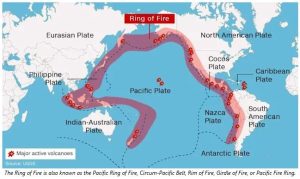
The Ring of Fire contains 750 to 915 active or dormant volcanoes, which is around two-thirds of the world’s total volcanoes. The exact number of volcanoes within the Ring of Fire depends on which regions are included. About 90% of the world’s earthquakes, including most of its largest, occur within this belt.
The Pacific Ring of Fire is not a single geological structure. It came into existence by the subduction of different tectonic plates at convergent boundaries around the Pacific Ocean. These subducted plates include the:
- Antarctic, Nazca and Cocos plates, which were subducted beneath the South American plate
- Pacific and Juan de Fuca plates, which were merged beneath the North American plate
- Philippine plate, which intruded beneath the Eurasian plate
- A complex boundary between the Pacific and Australian plates.
The interactions at these plate boundaries have formed very large oceanic trenches, volcanic arcs, back-arc basins and volcanic belts. The inclusion of some areas in the Ring of Fire, such as the Antarctic Peninsula and western Indonesia, is disputed.
The Ring of Fire has existed for more than 35 million years. But the presence of much older extinct volcanoes in some areas is an evidence that the subduction has existed for much longer in some parts of the Ring. More than 350 of the Ring of Fire’s volcanoes have been active in historical times, while the four largest volcanic eruptions on Earth in the Holocene epoch all occurred at volcanoes in the Ring of Fire.
Most of Earth’s active volcanoes with summits above sea level are located in the Ring of Fire. Many of these subaerial volcanoes are stratovolcanoes (e.g. Mount St. Helens), formed by explosive eruptions of tephra alternating with effusive eruptions of lava flows. Lavas at the Ring of Fire’s stratovolcanoes are mainly andesite and basaltic andesite, but dacite, rhyolite, basalt and some other rarer types also occur. Other types of volcano are also found in the Ring of Fire, such as subaerial shield volcanoes (e.g. Plosky Tolbachik), and submarine seamounts (e.g. Monowai)olcanoes (e.g. Mount St. Helens), formed by explosive eruptions of tephra alternating with effusive eruptions of lava flows. Lavas at the Ring of Fire’s stratovolcanoes are mainly andesite and basaltic andesite but dacite, rhyolite, basalt and some other rarer types also occur. Other types of volcano are also found in the Ring of Fire, such as subaerial shield volcanoes (e.g. Plosky Tolbachik), and submarine seamount (e.g. Monowai).
Where is the Ring of Fire?
Actually, the Ring of Fire is an elevated arc of mountains, volcanoes, and oceanic trenches that stretch from New Zealand northward along the eastern edge of Asia, then east across the Aleutian Islands of Alaska, and then south along the western coasts of North and South America.
Key Locations:
- Aleutian Arc: This is the zone where the Pacific Plate subducts under the North American Plate.
- Cascadia Subduction Zone: The zone at the coast of Cascadia that ranges from Northern California to Vancouver Island in Canada.
- Mexican Volcanic Belt: Also known as the Tans-Mexican Belt, Transvolcanic Belt and locally as the Sierra Nevada, where the Cocos Plate subducts under the North American Plate. It is an active volcanic belt that covers central-southern Mexico.
- Central America: Multiple subduction zones where the Cocos and Nazca plates dive under the Caribbean Plate.
- Andes: Formed by the subduction of the Nazca Plate beneath the South American Plate.
- Philippines, Indonesia, and the Melanesian Arc: Where several plates, including the Philippine Sea Plate and the Australian Plate, interact.
Countries Located Along the Ring of Fire
The number of countries along the Ring of Fire varies depending on how strictly you define the region. Estimates range from 15 to 22 countries. Here are some of the most commonly included countries:
- North America: United States, Canada
- Central America: Mexico, Guatemala, Costa Rica, Panama, Nicaragua
- South America: Chile, Peru, Ecuador, Colombia
- Asia: Russia (Kamchatka Peninsula), Japan, Philippines
- Oceania: Indonesia, Papua New Guinea, New Zealand
Historical Background of the Pacific Ring of Fire
From Ancient Greek and Roman times until the late 18th century, volcanoes were considered to be associated with fire, based on the ancient belief that volcanoes were caused by fires burning within the Earth. This historical link between volcanoes and fire is preserved in the name of the Ring of Fire, due to the lack of knowledge about the fact that volcanoes do not burn the Earth with fire.
However, the orogenic belt of volcanic activity around the Pacific Ocean was known in the early 19th century; for example, in 1825 the pioneering volcanologist G. P. Scrope mentioned the chains of volcanoes around the Pacific Ocean’s rim in his book Considerations on Volcanoes. Three decades later, a book about the Perry Expedition to Japan commented on the Ring of Fire volcanoes as follows: “They [the Japanese Islands] are in the line of that immense circle of volcanic development which surrounds the shores of the Pacific from Tierra del Fuego to the Moluccas.” (Narrative of the Expedition of an American Squadron to the China Seas and Japan, 1852–54.) A comprehensive article published in Scientific American Magazine in 1878 with the title “The Ring of Fire, and the Volcanic Peaks of the West Coast of the United States”, which threw light on the phenomenon of volcanic activity around the boundaries of the Pacific. Early explicit references to volcanoes forming a “ring of fire” around the Pacific Ocean also include Alexander P. Livingstone’s book “Complete Story of San Francisco’s Terrible Calamity of Earthquake and Fire”, published in 1906, in which he describes “… the great ring of fire which circles round the whole surface of the Pacific Ocean.”
In 1912, the famous geologist Patrick Marshall presented the term “Andesite Line” that marked a boundary between islands in the southwest Pacific. The volcanoes of “Andesite Line” differ in volcanic structure and lava types. The concept was later extended to other parts of the Pacific Ocean. The Andesite Line and the Ring of Fire closely match in terms of location.
The development of plate tectonic theory in the early 1960s has provided the current explanation and understanding of the global distribution of volcanoes and earthquakes, including those in the Ring of Fire.
How the Ring of Fire Came into Existence?
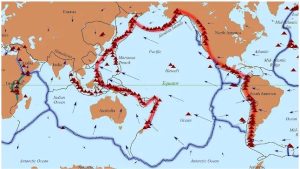
The lithospheric plates are continuously moving and colliding with one another. This movement is known as the tectonic movement. The Ring of Fire is a direct result of the movement, grinding and collision of the tectonic plates. The eastern section of the ring is the result of the Nazca Plate and the Cocos Plate being subducted beneath the westward-moving South American Plate. The Cocos Plate is being subducted beneath the Caribbean Plate, in Central America. A portion of the Pacific Plate and the small Juan de Fuca Plate are being subducted beneath the North American Plate. Along the northern portion, the northwestward-moving Pacific plate is being subducted beneath the Aleutian Islands arc. Farther west, the Pacific plate is being subducted along the Kamchatka Peninsula arcs on south past Japan. The southern portion is more complex, with a number of smaller tectonic plates in collision with the Pacific plate from the Mariana Islands, the Philippines, Bougainville, Tonga, and New Zealand; this portion excludes Australia, since it lies in the center of its tectonic plate.